

Company: Safety Innovators (International) Pte Ltd
Document Type: Company Policy
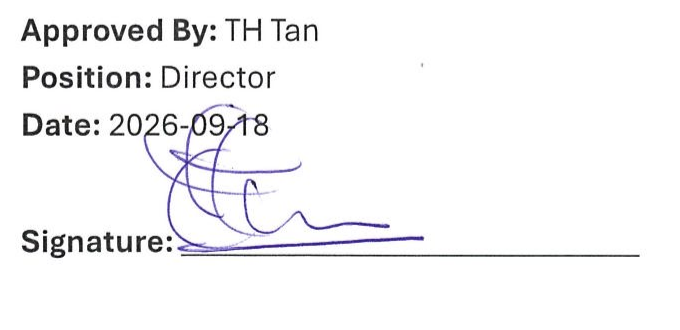
Effective Date: 2026-09-18
Revision: 1.0
- Purpose
The purpose of this policy is to prevent the use of unsolicited, inappropriate, or unauthorised messages and communications by employees, contractors, and representatives of Safety Innovators (International) Pte Ltd.
The policy is intended to protect the Company’s professional reputation, maintain good relationships with customers, suppliers, business partners, and other stakeholders, and ensure that all business communications are relevant, appropriate, and properly authorised.
- Scope
This policy applies to all employees, management, contractors, consultants, and other persons communicating on behalf of Safety Innovators (International) Pte Ltd.
It applies to all forms of business communication, including but not limited to:
- SMS and text messages
- WhatsApp and other messaging applications
- Social media messages
- Online communication platforms
- Marketing and promotional messages
- Telephone and voice messages
- Electronic newsletters
- Communications sent using Company accounts or equipment
- Policy Statement
Employees and representatives must not send unsolicited messages or communications to customers, suppliers, business partners, members of the public, or other external parties unless there is a legitimate business purpose and the communication has been appropriately authorised.
All external communications must be:
- Relevant to the recipient
- Related to a legitimate business purpose
- Professional and respectful
- Accurate and appropriate
- Sent to the correct recipient
- Consistent with the Company’s policies and procedures
- Compliant with applicable laws and regulations
- Prohibited Communications
The following are not permitted unless specifically authorised:
- Sending mass emails or messages to external parties without an approved business purpose.
- Sending promotional or marketing messages to persons who have not requested or consented to receive them, where consent is required.
- Sending repeated follow-up messages when the recipient has indicated that further communication is not required.
- Adding external parties to mailing lists, messaging groups, or distribution lists without appropriate authorisation.
- Sending irrelevant information, advertisements, jokes, chain messages, or non-business-related material using Company communication channels.
- Forwarding messages or documents to external parties who have no legitimate need to receive them.
- Contacting customers or suppliers for personal purposes using Company contact information.
- Using another employee’s email account or identity to send communications without authorisation.
- Sending messages that could reasonably be considered offensive, threatening, misleading, harassing, or inappropriate.
- Sending automated or bulk communications without prior approval from the appropriate manager
- Customer and Business Communications
Before contacting an external party, employees should consider:
“Does the recipient need or reasonably expect to receive this message?”
If the answer is no, the message should not be sent.
Where communication is required, employees should ensure that the message is directed only to the people who need to receive it.
Employees should avoid:
- Copying unnecessary recipients into emails
- Sending company-wide emails for matters concerning only specific individuals
- Combining unrelated tasks or requests in one email
- Sending internal instructions to external parties
- Sending external customers information intended only for internal personnel
Where several individuals have different responsibilities, separate communications should be sent to the appropriate individuals rather than sending one message containing unrelated requests to multiple recipients.
- Marketing and Promotional Communications
Marketing, promotional, advertising, or sales communications must only be conducted through approved Company channels and in accordance with applicable laws, regulations, and Company procedures.
Employees must not independently create or distribute bulk marketing messages without prior approval from management.
Any recipient who has requested that the Company stop sending communications must be removed from the relevant communication list or otherwise have their request appropriately addressed.
- Use of Messaging Applications
Company-related WhatsApp groups, SMS, instant messaging applications, and other communication platforms must be used responsibly.
Employees must not:
- Add external persons to Company groups without a legitimate business reason and appropriate approval.
- Send unrelated or excessive messages.
- Use business groups for personal discussions.
- Distribute unsolicited promotional material.
- Forward confidential Company information to unauthorised persons.
- Contact customers or suppliers outside reasonable business purposes or hours unless necessary.
- Approval and Authorisation
Employees who are uncertain whether a message should be sent to an external party must seek guidance from their immediate supervisor or management before sending it.
Mass communications, promotional campaigns, or communications to large external distribution lists should receive appropriate management approval before distribution.
- Respect for Recipients
The Company expects all employees to respect the communication preferences of customers, suppliers, contractors, and other stakeholders.
Where a recipient has:
- Asked not to be contacted;
- Unsubscribed from communications;
- Requested removal from a mailing list; or
- Indicated that further communication is unnecessary,
employees must respect the request and avoid further unsolicited communications, except where communication is required for a legitimate contractual, legal, safety, or operational purpose.
- Personal Responsibility
Employees are responsible for the messages they send using Company communication systems or while representing the Company.
Before sending a message, employees should check:
- Recipient: Am I sending this to the correct person?
- Purpose: Is there a legitimate business reason?
- Content: Is the information relevant and appropriate?
- Recipients: Does everyone copied on the message need to receive it?
- Timing: Is the communication being sent at a reasonable time?
- Authorisation: Do I have the authority to send it?
- Confidentiality and Data Protection
Employees must take reasonable care to protect customer, supplier, employee, and Company information.
Unsolicited communication must not be used as a reason to disclose confidential, personal, commercially sensitive, or proprietary information to unauthorised persons.
All communications must comply with the Company’s confidentiality and data protection requirements and applicable Singapore laws and regulations.
- Non-Compliance
Failure to comply with this policy may result in corrective or disciplinary action, depending on the nature and severity of the violation.
Where an employee is unsure whether a communication is appropriate, they should seek management guidance before sending the message.
- Management Responsibility
Management is responsible for:
- Communicating this policy to employees.
- Providing appropriate guidance on external communications.
- Ensuring employees understand their responsibilities.
- Reviewing reported instances of inappropriate or unsolicited communication.
- Taking appropriate corrective action where necessary.
- Review
This policy shall be reviewed periodically by management to ensure that it remains appropriate, effective, and consistent with applicable legal and regulatory requirements.